125th anniversary · 1901–2026
In the Footsteps of Saint John Baptist Scalabrini
One hundred days across the United States, walking with migrants
From August 3 to November 12, 1901, Scalabrini crossed the United States to encounter immigrant communities, listen to his missionaries and advocate for the dignity of those beginning a new life. This expanded web edition brings together the journey’s chronology with the pastoral institutions, missionary network and spirituality that sustained it.
Scalabrini Arrives in New York
On August 3, 1901, Bishop John Baptist Scalabrini arrived in New York aboard the Italian steamship Liguria. His arrival marked the beginning of an extraordinary one-hundred-day journey through the United States.
Before the ship reached the dock, priests and representatives of the Italian community traveled out to greet him aboard the George Starr. Two children, Katie Rappetti and a child identified in the historical account as Molinelli, welcomed him on behalf of the community. Scalabrini expressed his joy at finding himself among his people “in this land of freedom.”
From the pier, he was escorted through the city to Saint Joachim’s Mission on Roosevelt Street. The mission became his residence and headquarters in New York.
During his first days, Scalabrini met his missionaries, received journalists, toured Manhattan with Archbishop Michael Corrigan, visited Ellis Island, and went to the Italian mission of Our Lady of Pompeii.
He had come on behalf of Pope Leo XIII, but he was not conducting a ceremonial tour. He wanted to see the living conditions of immigrants personally. He wished to understand the dangers they encountered, the condition of their parishes and families, and the effectiveness of the institutions created to assist them.
His presence also drew reporters into Italian neighborhoods that had usually appeared in the press only in connection with poverty, crime, or ethnic stereotypes. More than twenty-five newspapers eventually reported on the journey, helping Scalabrini present a different image of Italian immigrants to the American public.
“I am happy to be among you in this land of freedom.” — Scalabrini’s greeting upon arriving in New York, August 3, 1901
Saint Raphael House: Welcome Beginning at the Port
On August 10, 1901, Bishop John Baptist Scalabrini blessed Saint Raphael House in New York, one of the works created to welcome, guide, and protect Italian immigrants arriving in the United States.
For Scalabrini, care for migrants could not begin only after they had settled in a parish. It had to accompany them throughout the entire migration journey, from the port of departure, across the Atlantic, through the port of arrival, and into the cities where they would begin a new life.
At the time of Scalabrini’s visit, Fr. Giacomo Gambera was Provincial of the Scalabrinian Province in the United States. There was then only one U.S. province, covering New England, New York, and the Midwest.
To welcome Bishop Scalabrini and document the missionary presence he had come to visit, Fr. Gambera commissioned an artist to paint a series of watercolors representing all the Scalabrinian missions then operating in the United States. The paintings were prepared as a gift for the Bishop.
The watercolor accompanying this post belongs to that remarkable series.
Rather than simply showing a building, it presents the mission symbolically: a steamship crosses the Atlantic while an angel, holding the Cross, guides it toward New York. In the distance appears the Statue of Liberty, the powerful symbol that greeted millions of immigrants approaching the United States.
The image captures the very heart of the Saint Raphael mission: to accompany migrants during a journey filled with hope, uncertainty, separation, and risk, and to help them reach their new destination with dignity and protection.
This concern was deeply practical. Newly arrived immigrants often had little money, spoke little or no English, did not understand American institutions, and had few reliable contacts. They could easily become victims of exploitation, dishonest agents, or fraudulent intermediaries.
The Saint Raphael Society sought to respond to those vulnerabilities by offering trustworthy assistance and by helping immigrants make the difficult transition from arrival to settlement.
During this same week, on August 15, Scalabrini continued his journey by visiting the Italian community in Newark and spending time at Holy Rosary Church in Jersey City. His itinerary shows that he was not simply inspecting institutions. He was meeting the people they served and trying to understand firsthand the realities faced by immigrant families.
The watercolor commissioned by Fr. Gambera therefore gives us something especially valuable 125 years later: a visual record created during Scalabrini’s own visit, showing how his missionaries understood their mission among people on the move.
For Scalabrini, migration was never only about crossing an ocean. It was about accompanying a person from uncertainty toward a place where a new life could begin.
A migrant should never be abandoned between the port of departure and the city of arrival.
Forming Missionaries for a People on the Move
From August 19 to 24, Scalabrini preached a retreat for more than forty priests at Saint Joseph’s Seminary in Yonkers.
This stage of the journey reveals an essential part of his method. Scalabrini did not think that immigrant ministry could depend only on good intentions. Missionaries needed spiritual formation, cultural sensitivity, discipline, knowledge of migration, and the ability to work in difficult urban environments.
Many immigrants had left communities where religion was deeply connected with family life, local devotions, saints’ feasts, and familiar languages. In the United States, they often encountered churches shaped by other European traditions and clergy who did not understand Italian religious customs. The resulting misunderstandings could leave migrants feeling alienated both from society and from the Church.
Scalabrini therefore wanted missionaries who could preserve what was valuable in the immigrants’ faith while helping them participate fully in the life of their new country.
His Spirituality of Incarnation explains the deeper foundation of this work. Christian life was not meant to remain separated from history. Faith had to become visible in human relationships, social responsibility, education, charity, and solidarity. The Incarnation continued, in a spiritual sense, whenever Christians made Christ’s love present within the concrete conditions of human life.
The retreat at Yonkers was therefore not a pause from the migrant mission. It was part of the mission. Before missionaries could accompany displaced people, they had to allow prayer, humility, sacrifice, and pastoral charity to shape their own lives.
To accompany migrants faithfully, the missionary must unite prayer, knowledge, and service.
New Haven Welcomes Scalabrini with Flags, Music, and Light
On the evening of August 31, Scalabrini arrived by train in New Haven, Connecticut.
Italian societies, bands, parishioners, and families had gathered at the station long before his arrival. Contemporary newspaper reports described red ceremonial fire, several musical bands, society uniforms, banners, American flags, Italian flags, and colored lanterns carried through the streets.
The procession traveled from the station to Saint Michael’s Church in Wooster Square. Every participating organization carried the American flag, the Italian flag, and its own society banner. The display expressed both attachment to the homeland and loyalty to the new country.
Saint Michael’s Church was illuminated with red, white, and blue electric lights. At the entrance, girls from the Society of Mary, dressed in white with veils and flower wreaths, greeted Scalabrini. One child, Josephine Daponte, delivered a formal welcome. The church was filled to the doors, and many people knelt as the bishop passed through the crowd.
For Italian immigrants, such a public reception had profound meaning. They were often described in newspapers through insulting stereotypes and were sometimes viewed as incapable of becoming responsible Americans. The New Haven celebration offered another image: organized families, religious associations, musicians, children, workers, and citizens publicly expressing faith and belonging.
Two flags did not represent two competing loyalties, but one community carrying its history into a new homeland.
Four Hundred Children in New Haven and a Triumphal Welcome in Boston
On September 1, Scalabrini celebrated Mass, preached, and confirmed approximately four hundred children at Saint Michael’s Church in New Haven.
The presence of so many children was especially significant. Scalabrini understood that the future of the immigrant community would depend on the younger generation. These children had to learn English and participate in American life, but they also needed families, parishes, and schools capable of transmitting faith, dignity, and a knowledge of their heritage.
On September 5, Scalabrini arrived in Boston. Approximately thirty Italian religious societies participated in his reception. Historical reports describe a procession of nearly one hundred carriages moving through streets decorated with lanterns, lights, and Italian and American colors.
The scale of the welcome showed how strongly immigrant communities desired recognition from both the Church and American society. Scalabrini’s visit assured them that their struggles had not been forgotten by the Church in Italy or by Pope Leo XIII.
At the same time, his public presence helped challenge anti-Italian prejudice. Italian immigrants were frequently portrayed as ignorant, dangerous, or incapable of civic responsibility. By visiting their neighborhoods, addressing their families, and meeting American religious and civic leaders, Scalabrini placed their labor, faith, and aspirations before a broader audience.
Throughout the journey, he would give hundreds of talks. 100 Days reports that he delivered 298 addresses during the visit, many of which were quoted or summarized by American newspapers.
The Boston newspaper page reproduced in 100 Days placed Scalabrini’s appeal for prayer prominently before the public. This coverage helped present Italian immigrants not as outsiders but as people capable of civic solidarity, religious compassion, and concern for the nation.
Where others saw a foreign population, Scalabrini saw children, families, communities, and the future of America.
Prayer for President McKinley and Solidarity with the Nation
Scalabrini’s Boston visit coincided with a national crisis. President William McKinley had been shot in Buffalo on September 6, 1901.
A large procession involving approximately thirty religious organizations had been planned in Scalabrini’s honor. As an act of respect and solidarity, he asked that it be canceled and called upon the people to pray for the president.
The decision communicated an important message: Italian Catholics were not isolated from the joys and tragedies of the United States. They belonged to the national community and shared concern for its leaders and institutions.
During Mass on September 8, the feast of the Nativity of the Blessed Virgin Mary, Scalabrini connected Marian devotion with the tragedy affecting the nation. Recalling the still-painful assassination of King Umberto I, he described the attack on McKinley as a wound reopening in their hearts and prayed for the president’s recovery:
“Full of anxiety we raise to God our prayer for the prompt cure of the distinguished patient, and from our hearts we say to Him: Lord, save the president of the republic.” — The Scalabrinians in North America, printed p. 96 (PDF page 102), note 324, citing the notes for Scalabrini’s Boston address of September 8, 1901, in Scritti II, pp. 221–222.
During this period, Scalabrini visited the seminary at Brighton, the Italian community in Winthrop, a Polish mission in South Boston, and the Italian church in Orient Heights. His visit to a Polish mission is important because it demonstrates that his concern extended beyond Italian migrants. The pastoral challenges of migration, language barriers, isolation, poverty, cultural misunderstanding, and the loss of religious community, affected many peoples.
On September 12, he traveled to Utica and then continued to Syracuse.
The faith of migrants does not isolate them from their new country; it teaches them to share its suffering and its hopes.
Utica: Laying a Foundation for Faith and Community
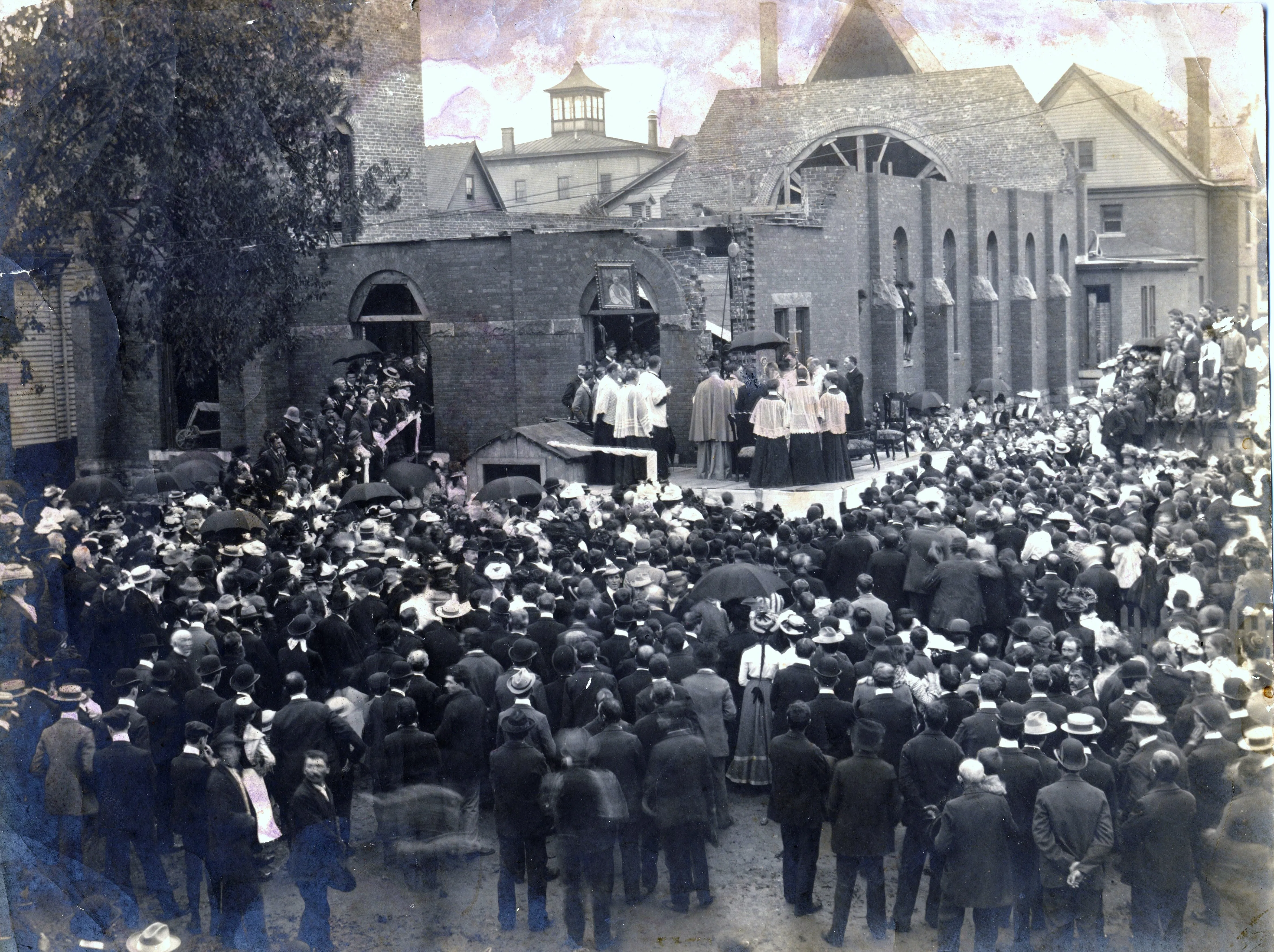
On September 15, 1901, Scalabrini returned from Syracuse to Utica. At 3:30 in the afternoon, he blessed the cornerstone of the new Saint Mary of Mount Carmel Church.
A remarkable historical photograph shows Scalabrini, clergy, and a large crowd gathered in the rain beside the unfinished church. Umbrellas cover much of the foreground while the walls of the future building rise behind the ceremony. The photograph communicates both hardship and determination.
For immigrant communities, a church was rarely only a place for Sunday worship. It could serve as a school, meeting place, source of emergency assistance, center of cultural continuity, and bridge to the wider city. Parish societies helped families find work, care for the sick, organize funerals, educate children, and maintain community bonds.
Scalabrini understood that immigrants needed stable institutions. Without them, poverty, discrimination, language barriers, and isolation could confine families to the margins of urban life.
After Utica, he traveled to Buffalo, visited the school connected with Saint Anthony’s Church, made a brief visit to Niagara Falls, continued to Cleveland, and arrived in Detroit on September 21.
The journey through these industrial cities brought him close to immigrants who labored in construction, commerce, factories, transport, and difficult manual occupations. Many had originally expected to earn money and return to Italy, but gradually found themselves building permanent lives in America.
A cornerstone is more than a stone when a migrant community is building a spiritual and social home.
Detroit, Chicago, Saint Paul, and Kansas City: A Mission Measured in Miles
On September 22, Scalabrini celebrated a Pontifical Mass at Saint Francis Church in Detroit. The following day, he met Bishop John Foley and visited the local seminary.
On September 24, he departed from Detroit and traveled through Chicago toward Saint Paul, Minnesota. The train journey lasted approximately twenty-three hours. In Saint Paul, he stayed with Archbishop John Ireland, visited seminaries, and began making arrangements for an audience with the new president, Theodore Roosevelt.
On September 27, Scalabrini departed for Kansas City. After another journey of approximately twenty hours, he arrived on September 28.
Rail travel allowed Scalabrini to cover enormous distances, but the journey was physically demanding. He was already in his early sixties, had a demanding schedule, and frequently preached, confirmed children, received visitors, met bishops, inspected institutions, and traveled again with little rest.
His actions reflected a central pastoral principle: the shepherd had to go where the people were. Migrants could not always travel to established Catholic centers, especially when they worked long hours or lived in neighborhoods without adequate pastoral care.
The broader history of the congregation shows that Scalabrinian missionaries often traveled great distances to reach scattered communities. Whether by ship, train, horse, or riverboat, mobility became a defining characteristic of a congregation founded for people who were themselves continually on the move.
He did not wait for migrants to find the Church. He carried the Church to the places where migrants lived and worked.
Kansas City and Saint Louis: Faith, Education, and Responsible Citizenship
On September 29, Italian societies organized a procession to escort Scalabrini from Bishop John Hogan’s residence to the Italian church in Kansas City.
Bands played, banners moved in the wind, and a large crowd filled the area around the church. The building was already full before the Confirmation ceremony began, while hundreds of people remained outside hoping to enter. A newspaper account noted the presence of numerous families and even very young babies brought to the celebration.
Scalabrini preached in the morning, confirmed approximately sixty children in the afternoon, and visited a Redemptorist church in the evening.
He then continued to Saint Louis, where he met the archbishop and discussed the possibility of obtaining a new church for the Italian community.
In his addresses, Scalabrini repeatedly encouraged immigrants to remain united, educate their children, learn the language of their new country, obey just laws, and participate responsibly in civic life. At the same time, he did not believe that integration required the destruction of their heritage.
He viewed the immigrants’ traditions, work ethic, family bonds, and faith as gifts that could enrich American society. Integration, in this vision, was neither isolation nor cultural disappearance. It was a process through which migrants became active members of their new country while preserving the values that strengthened family and community life.
Integration does not require migrants to forget where they came from; it invites them to contribute what is best in their heritage.
Scalabrini Brings the Immigrant Question to President Theodore Roosevelt
After visiting Cincinnati and Columbus, Scalabrini traveled approximately nineteen hours to Washington, D.C.
On October 10, 1901, at 10:00 a.m., he was received by President Theodore Roosevelt. Roosevelt had assumed the presidency only weeks earlier, following the death of William McKinley.
The conversation took place across languages: Roosevelt spoke in English, and Scalabrini spoke in French. According to the historical account, they nevertheless understood one another and held a cordial discussion.
Scalabrini defended the character and contribution of Italian immigrants. He emphasized their hard work, sobriety, perseverance, respect for morality, and generally law-abiding conduct. He also challenged the negative stereotypes that presented Italians primarily through criminality or disorder.
More importantly, he spoke about the injustices migrants experienced. He called attention to abuses surrounding immigration and advocated improved reception and protection, including better conditions connected with Ellis Island.
This meeting illustrates Scalabrini’s complete approach to pastoral care. He did not limit himself to sacramental ministry. He spoke with religious leaders, the press, associations, public officials, and the president because the welfare of migrants was also shaped by laws, institutions, labor conditions, and public opinion.
On October 11, he visited Cardinal James Gibbons in Baltimore. The following day, he returned to New York.
On October 10, 1901, the concerns of immigrant families reached the President of the United States.
The Catholic Club Address: Migration and the Unity of Humanity
On October 13, Scalabrini confirmed approximately 750 children and young people from Saint Joachim’s and Our Lady of Pompeii in New York.
Two days later, on October 15, he was formally received at the Catholic Club of New York on West 59th Street. Church leaders, priests, representatives of the Italian community, and prominent guests attended the reception.
The occasion gave Scalabrini an opportunity to explain his wider vision of migration and history. He spoke of America as a place where peoples, cultures, and traditions were meeting on an unprecedented scale.
He did not romanticize migration. He had seen separation, poverty, exploitation, prejudice, and religious abandonment. Nevertheless, he believed that human mobility could become part of a greater process of encounter and unity.
In the address, he observed that while societies were being transformed by machines, discoveries, commerce, and the movement and mixing of peoples, a greater work was also unfolding: “the union in God through Jesus Christ of all men of good will.”
This conviction was part of his spirituality of the Incarnation. History was not outside God’s concern. Christians were called to work within social change, guiding it toward justice, fraternity, reconciliation, and respect for human dignity.
The Catholic Club event also gave American leaders an opportunity to hear a positive defense of Italian immigrants and the institutions already serving them. Contemporary accounts mentioned twenty-four churches founded in the United States by Scalabrinian missionaries, as well as the Saint Raphael Society and other charitable works.
“Above the roar of our machines … a much vaster, nobler, more sublime work is developing: the union in God through Jesus Christ of all men of good will.” — Address at the Catholic Club of New York, October 15, 1901
Providence: Building a Church and Investing in the Next Generation
On October 20, Scalabrini presided at the dedication of Holy Ghost Church in Providence, Rhode Island.
The ceremonies lasted throughout the day. Approximately one hundred Italian priests assisted at the principal celebration, and Scalabrini presided and offered his blessing. The church was designed to seat about 1,500 people. Contemporary reporting described its Romanesque architecture, Italian limestone details, and projected cost of approximately $68,000.
The size of the building demonstrated the growth and determination of the Italian community. Immigrants who often earned modest wages contributed to constructing a permanent house of worship for their families.
In his message, Scalabrini emphasized education. He wanted immigrant children to benefit from the opportunities available in the United States. Families should help them acquire knowledge, learn a trade, develop their talents, and become active participants in society.
After Providence, he visited Worcester and later returned to Boston. There, he confirmed children in a Polish community and made plans to purchase a house for an Italian school and an orphanage.
This combination, church, school, orphanage, and community organization, was characteristic of the Scalabrinian mission. Religious care was inseparable from the protection and development of the whole person.
Education was especially urgent. Without language skills or training, migrants could remain confined to dangerous, low-paid employment. Schools could help children retain their faith and family identity while also preparing them for full participation in American life.
A church gives a community a spiritual home; a school gives its children the tools to build the future.
Returning to New York and Preparing the Mission’s Future
On October 28, Scalabrini returned to New York. The following day, he visited Saint Raphael House once more.
His return to the house near the end of the journey was significant. It brought him back to one of the practical centers of migrant assistance: a place where newly arrived people could receive guidance, protection, and pastoral support.
On October 30, he began a retreat for four young men preparing to be ordained priests.
After traveling across the country, meeting immigrants and bishops, visiting institutions, and observing local needs, Scalabrini turned toward the continuation of the work. His personal presence could inspire communities, but the mission required trained people who would remain after he departed.
The broader history of the congregation shows how carefully missionary structures had to be developed. Priests needed theological and philosophical preparation, but they also needed the ability to adapt to different countries, travel long distances, establish parishes, teach, organize associations, and defend migrants from exploitation.
Scalabrini’s vision extended beyond an occasional ethnic ministry. He sought a permanent missionary network connecting the places of departure, the ships crossing the Atlantic, the ports of arrival, and the cities of settlement.
The retreat therefore represented continuity. The one-hundred-day visit would eventually end, but new priests, parishes, schools, houses, and charitable institutions could carry its purpose into future generations.
A pastoral visit becomes a lasting mission when new people are prepared to continue the work.
Four New Missionaries Ordained for the Immigrant Mission
On November 3, 1901, Scalabrini ordained four new missionaries at Our Lady of Pompeii Church in New York.
The ordination was one of the most important concrete fruits of his visit. The young priests would help carry forward a ministry shaped by the needs Scalabrini had witnessed personally: crowded immigrant neighborhoods, children requiring religious education, workers isolated by language, families without stable parishes, and new arrivals vulnerable to abuse.
The following day, November 4, Scalabrini celebrated the feast of Saint Charles Borromeo, patron of the congregation he had founded in 1887.
Saint Charles Borromeo represented pastoral reform, disciplined clergy, education, and attention to the spiritual needs of the people. These qualities became especially meaningful for missionaries working among migrants, whose communities could easily be overlooked by established institutions.
During this final period, Scalabrini also visited the Italian community in Brooklyn and celebrated Confirmations in Newark.
The new missionaries were expected to understand both continuity and adaptation. They had to speak to immigrants in a language they understood and respect their devotions, but they also had to prepare families for life in a new society. Their ministry would help immigrants remain rooted in faith without becoming isolated from American civic and ecclesial life.
Four new priests were ordained so that migrant families would not have to walk alone.
The Farewell: One Hundred Days End, but the Mission Remains
On November 10, Scalabrini blessed an orphanage in Newark, one final expression of his concern for children and families in vulnerable circumstances.
On November 12, 1901, a large crowd gathered in the rain at Pier 40 in New York to say farewell. Priests, religious, association representatives, community leaders, families, and immigrants assembled near the Liguria.
At approximately eleven o’clock in the morning, the ship began to move away from the harbor. Scalabrini’s one-hundred-day visit to the United States had come to an end.
During those months, he had traveled from the Atlantic coast to the Midwest. He had visited New York, New Jersey, Connecticut, Massachusetts, Rhode Island, New York State, Ohio, Michigan, Minnesota, Missouri, Washington, D.C., and Maryland. The itinerary included parishes, seminaries, schools, houses of welcome, orphanages, bishops’ residences, public receptions, and the White House.
He had delivered 298 talks and attracted coverage from more than twenty-five newspapers. His journey brought reporters into immigrant neighborhoods that had often received attention only when crime or scandal was involved. Through his words and presence, he presented Italian immigrants as workers, parents, believers, community builders, and future citizens.
The deeper legacy was institutional and spiritual. Scalabrinian missionaries, Saint Raphael initiatives, port ministries, parishes, schools, orphanages, and immigrant associations would continue serving communities after his departure.
His spirituality gave this work a universal horizon. Migration was painful and required protection, but it could also bring peoples into encounter. The goal was not uniformity but a human family united without barriers of hostility and division.
One hundred and twenty-five years later, the journey still asks a question: How will our communities receive the migrant who arrives today?
The ship left New York, but the mission remained in America.
1901 2026
A journey that became a mission
The visit ended in New York Harbor, but its commitments endured: welcome at the port, protection from exploitation, education, pastoral care and full participation in a new society. In 2026, the 125th anniversary invites us to read this history as a living responsibility.
This stage of Saint John Baptist Scalabrini’s journey took place 125 years ago. Today, we continue walking with migrants, refugees and people on the move.